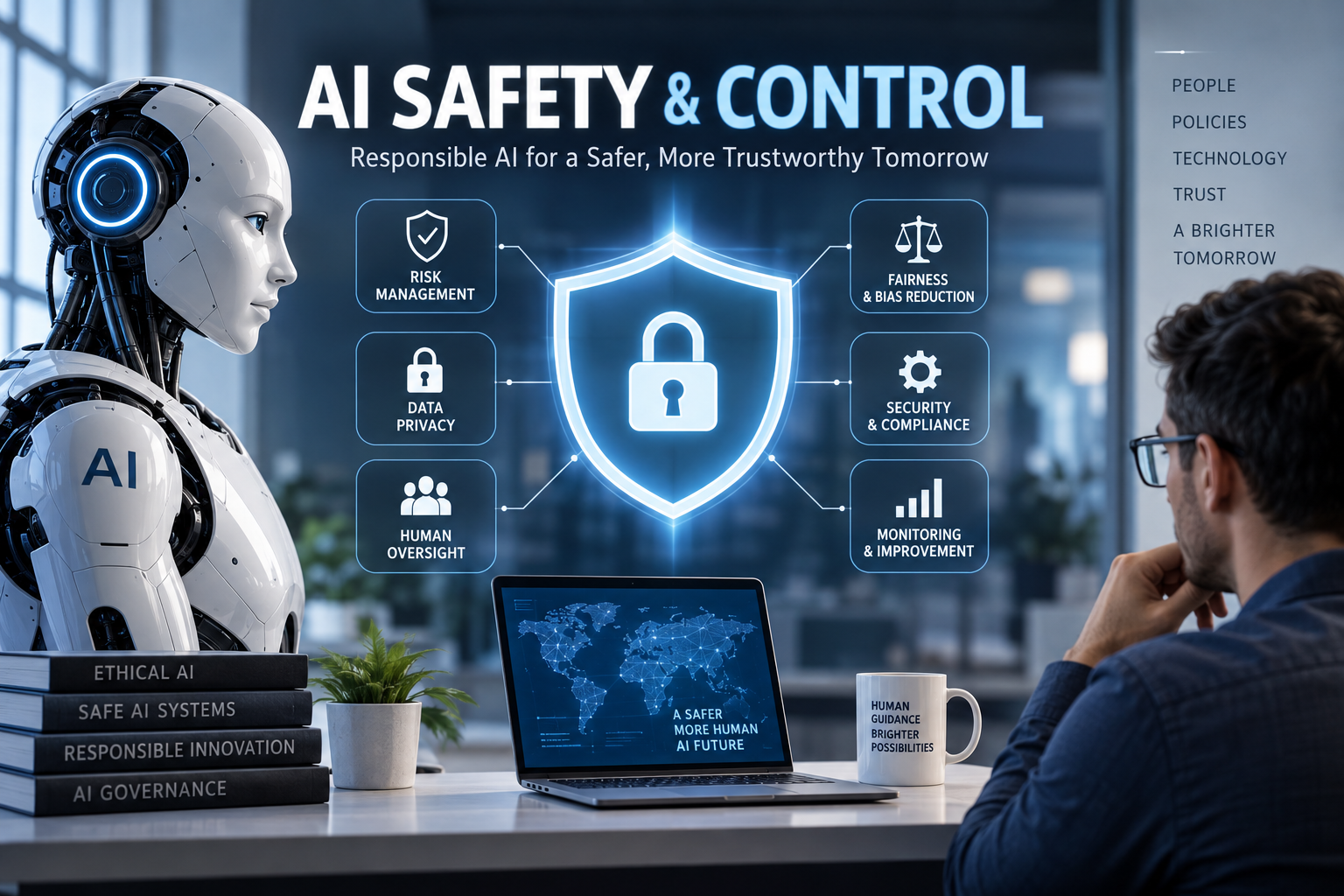
Artificial intelligence is moving from experimental technology to an everyday business tool. AI can analyze massive datasets, automate decisions, write software, detect fraud, and transform customer experiences. But as AI systems become more capable, one question becomes increasingly important: How do we make sure AI remains safe, reliable, and under human control?
That is where AI safety and control come in. From cybersecurity and AI risk management to human oversight and responsible development, these practices help organizations benefit from artificial intelligence while reducing unintended consequences.
What Is AI Safety & Control?
AI safety refers to the methods used to ensure artificial intelligence systems behave reliably, avoid causing unnecessary harm, and operate within clearly defined boundaries.
AI control focuses on maintaining meaningful human oversight over AI systems, particularly when they can make decisions, access sensitive information, use external tools, or take actions autonomously.
Together, AI safety and control address several major concerns:
- Unintended or harmful AI behavior
- Data privacy and security
- Biased or discriminatory decisions
- Incorrect or misleading AI-generated information
- Unauthorized system access
- Excessive automation without human review
- Risks from increasingly autonomous AI agents
The goal isn’t to stop AI innovation. Instead, it is to make advanced AI more trustworthy, predictable, and manageable.
Why Is AI Safety Important?
The potential value of AI is enormous, but mistakes can become costly when AI is integrated into critical systems.
For example, imagine an AI system used to evaluate loan applications. If its training data contains historical biases, the system could unintentionally produce unfair outcomes. Similarly, an AI customer-service agent might provide incorrect financial or legal information if it operates without appropriate safeguards.
AI safety helps organizations identify these risks before they become real-world problems.
AI Safety in Business
For companies, responsible AI can protect more than customers. It can also protect revenue, reputation, intellectual property, and regulatory compliance.
Businesses should consider:
- Risk assessment: Identify what could go wrong before deploying an AI system.
- Access controls: Limit what AI applications, employees, and automated agents can access.
- Human oversight: Require people to review high-impact decisions.
- Testing: Evaluate systems for accuracy, bias, security vulnerabilities, and unexpected behavior.
- Monitoring: Continuously track AI performance after deployment.
These practices form an important part of modern AI risk management.
Key Principles of AI Control
Effective AI control is not based on a single safety feature. It requires multiple layers of protection.
Human-in-the-Loop Oversight
Human review is especially important when AI affects healthcare, employment, finance, legal decisions, security, or other high-impact areas.
A practical approach is to define situations where AI can act independently and situations where it must request human approval.
AI Alignment and Reliability
AI alignment broadly concerns whether an AI system’s behavior matches its intended objectives and human expectations.
Organizations can improve alignment by giving systems clear instructions, defining prohibited actions, testing edge cases, and evaluating whether outputs remain consistent with their intended purpose.
Security and Data Protection
AI systems can introduce new cybersecurity risks. Sensitive information may be exposed through poorly configured applications, insecure integrations, or excessive permissions.
Strong AI security practices include encryption, authentication, least-privilege access, secure development, logging, and regular vulnerability testing.
Continuous Monitoring
Testing an AI model before launch isn’t enough. Models can behave differently as users, data, environments, and integrations change.
Organizations should monitor accuracy, unusual outputs, security events, user feedback, and changes in system behavior. Automated alerts can help teams investigate problems quickly.
Practical Steps for Safer AI
Whether you’re building an AI product or introducing AI into your business, start with a structured process:
Define acceptable behavior. Clearly document what the system should and should not do.
Classify risk. A chatbot answering general questions requires different controls from an AI making financial recommendations.
Use layered safeguards. Combine technical restrictions, monitoring, authentication, testing, and human review rather than relying on one mechanism.
Test adversarial scenarios. Try to make the system fail. Examine prompt injection, misleading inputs, unexpected requests, data leakage, and unusual edge cases.
Keep humans accountable. Someone should ultimately be responsible for important AI-driven outcomes.
Document everything. Maintain records of system capabilities, limitations, testing results, incidents, and changes.
The Future of AI Safety & Control
As AI agents become capable of performing increasingly complex tasks, controlling AI systems will become even more important. Future AI governance is likely to combine technical safeguards with organizational policies, independent evaluations, security standards, and evolving regulations.
The most successful organizations won’t simply ask, What can AI do? They’ll also ask, What should AI do, what shouldn’t it do, and how can we verify the difference?
Conclusion
AI safety and control are essential foundations for responsible artificial intelligence. As AI becomes more powerful and deeply integrated into business and society, organizations need practical systems for managing AI risk, protecting data, monitoring behavior, and maintaining human oversight.
The key takeaway is simple: safe AI isn’t achieved by one rule or one technology. It comes from combining careful design, rigorous testing, strong security, continuous monitoring, and meaningful human control. By building these safeguards into AI systems from the beginning, businesses can pursue innovation while creating technology people can trust.